
Top Tips for Getting Started with Times Tables
Updated: Sep 23, 2025
I’ll be honest, I got through school and teaching without ever learning all my times tables off by heart. Now, as a parent helping my 10-year-old with 11+ prep, I can see what a difference it makes! Times tables are like shortcuts in maths: they make everything quicker and easier, whether it’s calculating area, working with algebra, or spotting number patterns.
My son’s in Year 4 this year, which means he’ll be doing the Multiplication Check at the end of the summer. So, I’ve been thinking about the best ways to help him learn them and I thought I’d share what we’re doing in case it helps you too.
1. Teach them in the easiest order
Your child’s school probably won’t teach the tables in order (2s, then 3s, then 4s, and so on), because that isn’t the most effective way to learn them. Here’s how schools in England usually introduce them:
Year 2: 2s, 5s and 10s. These are the easiest ones, as children already practise counting in 2s, 5s and 10s and explore doubling in Year 1.
Year 3: 3s, 4s and 8s. The 3s build on what they’ve already learned in counting; the 4s are doubles of the 2s, and the 8s are doubles of the 4s.
Year 4: All the way up to 12 × 12. The 9s are a fun one to tackle first because there are lots of tricks to make them easier. After that, the 7s, 11s and 12s are left to fill in the gaps.
2. Vary the language you use
Children don’t always realise something is a multiplication problem unless it’s worded in the way they’re used to. It’s useful to mix things up.
For example, you might hear:
five groups of ten (or ten groups of five)
five times ten (or ten times five)
five multiplied by ten (or ten multiplied by five)
5 tens (or 10 fives)
the product of five and ten (which just means the new number you make when you multiply e.g. 50 is the product of 5 and 10)
Using different phrases will help your child understand that they all mean the same thing: multiply!
3. Use the commutative law
This sounds fancy, but it just means the order of the numbers doesn’t matter when multiplying: 7 × 2 is the same as 2 × 7. This isn't obvious to children at first. If you asked a child if they would rather have 7 packets with 2 sweets or 2 packets with 7 sweets they would probably pick the packs with 7 sweets because it sounds like more.

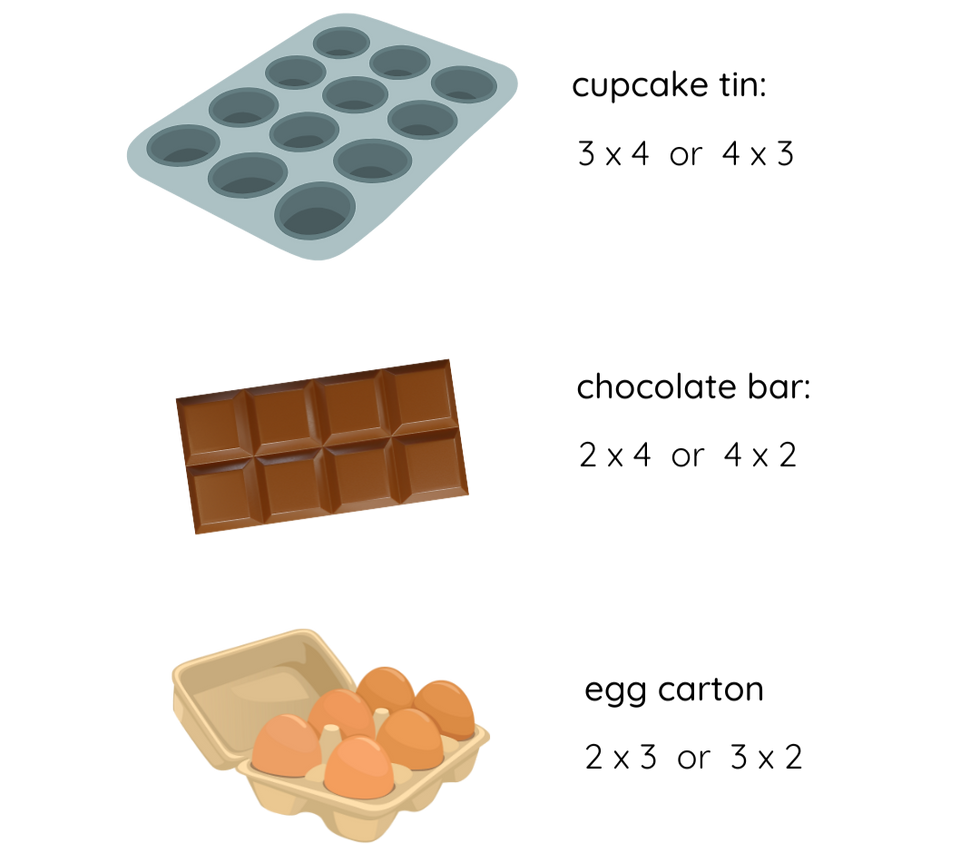
Schools often use arrays to make this clear. That’s just a set of dots in a rectangle. For example, draw 2 rows of 7 dots. If you turn the paper and look at it another way, you can also see 7 rows of 2 dots. You haven’t added any more dots, so both 2 × 7 and 7 × 2 give the same total.

This little trick is brilliant because it cuts the number of facts children need to learn. If they already know their 2s but not their 7s, they can flip the question around and still work it out.
Look out for arrays in every day life and talk about the multiplication fact.
4. Use tips and tricks
There are loads of patterns in the times tables that make them easier to remember. For example, every answer in the 5s ends in either 0 or 5. The 2s, 4s and 8s can all be worked out by doubling.
Spotting these patterns makes it feel less like rote learning and more like problem-solving.
The times tables posters (included in the times tables club) have patterns and tricks to help make learning them easier.

5. Make it fun!
This is the big one. The more relaxed and game-like it feels, the quicker it sticks. We use printable flashcards and quick games from the Times Tables Club, often over breakfast, but they work just as well after school.
If we get to school early and are sitting in the car, a few minutes on one of the online times tables game keeps practice ticking along without it feeling like work.
The main thing I’ve found is that times tables don’t need to feel like a slog. Keep it playful, mix in little tricks and notice arrays and patterns in everyday life.
And if you’d like more ready-made games and printables, they’re all in the Times Tables Club.


Comments